
How To
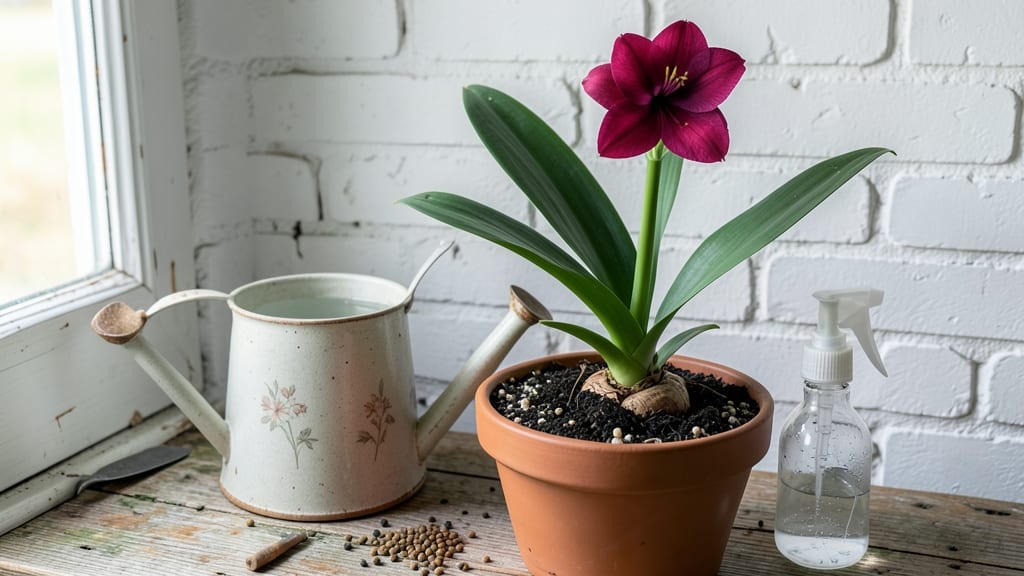
Caring for giant amaryllis turns a single bulb into a showstopper that blooms indoors or outdoors. 🌱 I’ve had mine push up 6-foot stems with trumpet-shaped flowers for years—here’s how to keep yours thriving without the fuss.
The secret lies in three simple rules: bright light (but no scorching sun), deep but infrequent watering, and a cool dormant period in winter. Most people overwater or skip the rest phase, which is why their plants fail to rebloom.
My bulbs now produce 2-3 stems per season because I treat them like the dramatic divas they are. You’ll spot the first flower bud in early spring, followed by weeks of bold blooms that smell faintly sweet.
The foliage stays lush year-round if you fertilize lightly during active growth, and the bulb itself grows bigger each year with proper care. Works equally well in pots on a sunny windowsill or planted outdoors in warm climates. Let’s get those blooms coming back every year!
Root Causes of Amaryllis Struggles
Giant amaryllis (Hippeastrum spp.) are stunning, hardy plants—but when they act out, it’s usually due to a few key factors. Understanding the science behind these issues helps you address them with precision. Let’s break down the most common culprits and why they disrupt your plant’s health.
Why it happens: Amaryllis bulbs are succulent by nature, meaning they store water and nutrients in their thick, fleshy roots. When soil stays soggy, the bulb’s cells suffocate from a lack of oxygen—a condition called anaerobic stress. This triggers:
- Rot fungi (Fusarium or Phytophthora), which thrive in waterlogged soil.
- Root asphyxiation, where roots can’t absorb oxygen, leading to yellowing leaves or a mushy bulb.
- Nutrient leaching, as excess water flushes out essential minerals like potassium and phosphorus, critical for blooming.
The science: Amaryllis bulbs need well-aerated soil with a pH of 6.0–7.0 for optimal nutrient uptake. Water should drain within 1–2 hours of watering. If your pot lacks drainage holes or the soil is too dense (like clay-heavy mixes), water pools around the bulb, creating the perfect storm for rot.
Why it happens: Giant amaryllis crave bright, indirect light (6+ hours daily) to fuel photosynthesis and trigger flowering. When deprived, they exhibit:
- Leggy, weak stems (etiolation), as the plant stretches toward light sources.
- Small or no blooms, because low light disrupts the photoperiodism (light-dark cycle) needed to initiate flower buds.
- Pale, yellowing leaves, signaling chlorophyll breakdown due to insufficient energy production.
The science: Amaryllis rely on blue and red light wavelengths to regulate growth hormones like auxin (promotes stem elongation) and gibberellins (stimulates flowering). Without enough light, auxin dominates, causing rapid but weak growth. In extreme cases, the bulb may revert to a dormant state prematurely, halting blooms entirely.
Why it happens: Amaryllis are tropical natives but need a cool shock (50–55°F/10–13°C) for 6–8 weeks to break dormancy and produce flower spikes.
Outside this range, problems arise: - No blooms: If temps stay above 70°F (21°C) year-round, the bulb skips its flowering cycle. - Drooping leaves: Sudden cold snaps (below 40°F/4°C) cause cold stress, disrupting cellular metabolism. - Mold or mites: High humidity (above 70%) without airflow encourages powdery mildew or spider mites, which weaken the plant.
The science: Amaryllis use temperature fluctuations to cue dormancy and regrowth. The bulb’s meristem (growth center) requires a cool period to reset its biological clock. Without it, the plant stays in a vegetative state. Additionally, relative humidity affects stomatal opening (pores on leaves)—too dry, and they close, reducing photosynthesis; too humid, and fungal spores spread like wildfire.
Why it happens: While amaryllis need nutrients, too much fertilizer (especially nitrogen) leads to:
- Lush leaves, no flowers: Excess nitrogen promotes foliar growth at the expense of blooms, as the plant prioritizes leaves over reproductive structures.
- Burned roots: High salt concentrations from fertilizers (like synthetic mixes) disrupt osmosis, causing root cells to lose water and die.
- Stunted growth: A deficiency in phosphorus (P) or magnesium (Mg) (common in overwatered or acidic soils) leads to purple-tinged leaves or weak stems.
The science: Amaryllis thrive on a balanced 10-10-10 or 20-20-20 NPK ratio during active growth, with extra phosphorus (P) when flowering. However, their bulbs absorb nutrients slowly—over-fertilizing creates a salt buildup in the soil, making it harder for roots to take up water. This is why organic fertilizers (like worm castings) are gentler than synthetics.
Why it happens: Amaryllis bulbs double in size during dormancy.
Crowded roots lead to: - Stunted blooms: The bulb can’t allocate enough energy to flower spikes if roots are tangled. - Leaning stems: As the bulb grows, it may push against the pot’s edge, causing stems to bend awkwardly. - Root circling: Roots grow in a spiral, strangling themselves and reducing nutrient uptake.
The science: The bulb’s vascular system (xylem and phloem) relies on unrestricted root expansion to transport water and sugars. When roots hit the pot’s sides, ethylene gas (a plant stress hormone) accumulates, signaling the plant to halt growth or redirect energy to survival—often at the cost of flowers.
Why it happens: Amaryllis are vulnerable to:
- Bulb mites (Rhizoglyphus robini), which burrow into the bulb, causing silver-gray webbing and stunted growth.
- Amaryllis fly larvae (Liliodendron spp.), which lay eggs in soil, hatching into maggots that devour roots.
- Bacterial soft rot (Erwinia spp.), entering through cuts or overwatering, turning the bulb mushy and foul-smelling.
The science: Pests and pathogens exploit weakened defenses, often triggered by the issues above (e.g., overwatering invites mites). The bulb’s cuticle (protective outer layer) can crack from temperature swings or physical damage, creating entry points for infections. Once inside, microbes release enzymes that break down cell walls, leading to rapid decay.
Key Takeaway: Most amaryllis problems stem from misaligned growing conditions—whether it’s too much water, light, or fertilizer. By targeting the root cause (literally and figuratively), you can restore your plant’s health and coax those dramatic blooms back to life. 🌟
Fixing common giant amaryllis issues
Even the hardiest plants need a little TLC now and then, and your giant amaryllis (Hippeastrum) is no exception. If you’ve spotted drooping leaves, no blooms, or other signs of distress, don’t panic—most problems have simple fixes.
Below, we’ve mapped out the most common issues, step-by-step solutions, and easy prevention tips to keep your giant amaryllis thriving year-round.
Why it happens: Overwatering, underwatering, or poor drainage can cause leaves to yellow or wilt. Nutrient deficiencies or root rot (from soggy soil) are also culprits.
How to fix it: 🔥 Check the soil moisture – Stick your finger 1–2 inches into the soil. If it’s damp, hold off on watering. If it’s bone-dry, give it a deep drink. 🍳 Repot if needed – If the soil smells sour or the roots look mushy, repot into fresh, well-draining potting mix (like a cactus or succulent blend). 👨🍳 Adjust watering habits – Water only when the top 2–3 inches of soil are dry. Giant amaryllis prefer slightly dry conditions over soggy roots. ⏰ Fertilize lightly – Use a balanced, water-soluble fertilizer (10-10-10) diluted to half-strength every 4–6 weeks during the growing season (spring and summer).
Prevention tips: ✨ Use a pot with drainage holes – No exceptions! Without them, water pools at the bottom, suffocating roots. 💡 Avoid cold drafts – Keep your amaryllis away from AC vents or drafty windows, as cold stress can cause leaf issues. 🌡️ Monitor humidity – If your home is very dry (common in winter), mist the leaves occasionally or place the pot on a tray of pebbles with water.
Why it happens: Giant amaryllis need a period of dormancy (rest) to produce flowers. If they’re blooming less than before, it could be due to over-fertilizing, lack of sunlight, or inconsistent care.
How to fix it: 🔥 Induce dormancy – After blooming, reduce watering and stop fertilizing. Let the soil dry out completely for 6–8 weeks (this mimics winter conditions). 🍳 Move to bright, indirect light – Place your amaryllis near a south- or east-facing window where it gets 6–8 hours of light daily. If natural light is limited, supplement with a grow light. 👨🍳 Repot every 2–3 years – Crowded roots can stress the plant. Choose a pot just 1–2 inches larger in diameter and use fresh potting mix. ⏰ Fertilize at the right time – Resume feeding in early spring (when new growth appears) with a phosphorus-rich fertilizer (like 5-10-5) to encourage blooming.
Prevention tips: ✨ Be patient – It can take 6–8 weeks of dormancy before new flower buds form. Don’t water or fertilize during this time! 💡 Rotate the pot – If your amaryllis leans toward the light, gently turn the pot a quarter-turn every few weeks for even growth. 🎯 Avoid temperature swings – Keep your amaryllis in a stable environment (60–75°F during the day, slightly cooler at night).
Why it happens: These tiny pests love the sap in amaryllis leaves and bulbs. They thrive in dry, dusty conditions or when the plant is stressed.
How to fix it: 🔥 Isolate the plant – Move it away from other houseplants to prevent spreading. 🍳 Wipe leaves with soapy water – Mix 1 tsp mild dish soap in 1 quart of water, then gently scrub leaves with a soft cloth or sponge. 👨🍳 Spray with neem oil – Mix 1 tsp neem oil with 1 quart of water and ½ tsp mild soap. Spray the plant (including undersides of leaves) every 5–7 days until pests are gone. ⏰ Use insecticidal soap – For severe infestations, apply a store-bought insecticidal soap (like Safer® Brand) according to the label.
Prevention tips: ✨ Inspect new plants – Before bringing a new amaryllis home, quarantine it for a week and check for pests. 💡 Keep leaves dust-free – Wipe leaves with a damp cloth monthly to deter pests. 🌡️ Boost humidity – Pests love dry air. Use a humidifier or place a tray of water near the plant to keep the air moist.
Why it happens: If your amaryllis isn’t growing taller or producing larger bulbs, it may lack nutrients, light, or proper repotting.
How to fix it: 🔥 Repot into a larger container – If the bulb is crowded (roots circling the pot), upgrade to a pot 2–3 inches wider. 🍳 Use nutrient-rich soil – Mix in compost or a bulb-specific potting mix for better nutrition. 👨🍳 Fertilize regularly – Feed every 4–6 weeks with a balanced fertilizer during the growing season. ⏰ Give it more light – If leaves are pale or leggy, move it to a brighter spot or add a grow light.
Prevention tips: ✨ Divide bulbs every 3–4 years – If your amaryllis produces offsets (baby bulbs), separate them in spring and pot them individually. 💡 Avoid overwatering – Bulbs rot in soggy soil, which stunts growth. Water only when the soil is dry. 🎯 Keep it warm – Amaryllis grow best in temperatures above 60°F. Avoid placing them near cold windows or doors.
With these fixes, your giant amaryllis should bounce back—and with a little preventive care, it’ll reward you with stunning blooms for years to come! 🌺✨
Frequently asked questions
How often should I water my giant amaryllis?
Water only when the top 2-3 inches of soil are completely dry—usually every 7-10 days in spring/summer. Reduce to every 3-4 weeks during winter dormancy. Overwatering is the #1 killer of these bulbs! The thick roots store moisture, so they prefer dryness over soggy conditions.
Can giant amaryllis grow outdoors year-round?
Only in USDA zones 9-11 with winter protection. In colder climates, treat them as summer annuals or overwinter indoors. Plant bulbs in well-draining soil with full sun (6+ hours daily) and mulch heavily in winter. Frost will damage leaves but rarely kills the bulb itself.
Why did my amaryllis bloom once but not again?
Most likely skipped the 6-8 week dormant period after blooming. After flowers fade, stop watering completely and move to 50-55°F (cool but not freezing) for 2 months. Without this rest phase, the bulb won't store enough energy for next year's blooms. Try again this winter!
What's the best fertilizer for giant amaryllis?
Use a balanced 10-10-10 during active growth (spring-summer), but switch to 5-10-5 or 10-30-20 when buds form to encourage blooming. Apply every 4-6 weeks at half-strength. Organic options like worm castings work well too. Never fertilize during dormancy!
How do I know if my amaryllis bulb is healthy?
A healthy bulb feels firm and heavy for its size, with smooth, papery skin. Look for white roots emerging from the bottom and tightly packed scales inside. If it smells sour, feels mushy, or has black spots, it's rotting from overwatering. Healthy bulbs should double in size every few years with proper care.