
Tools
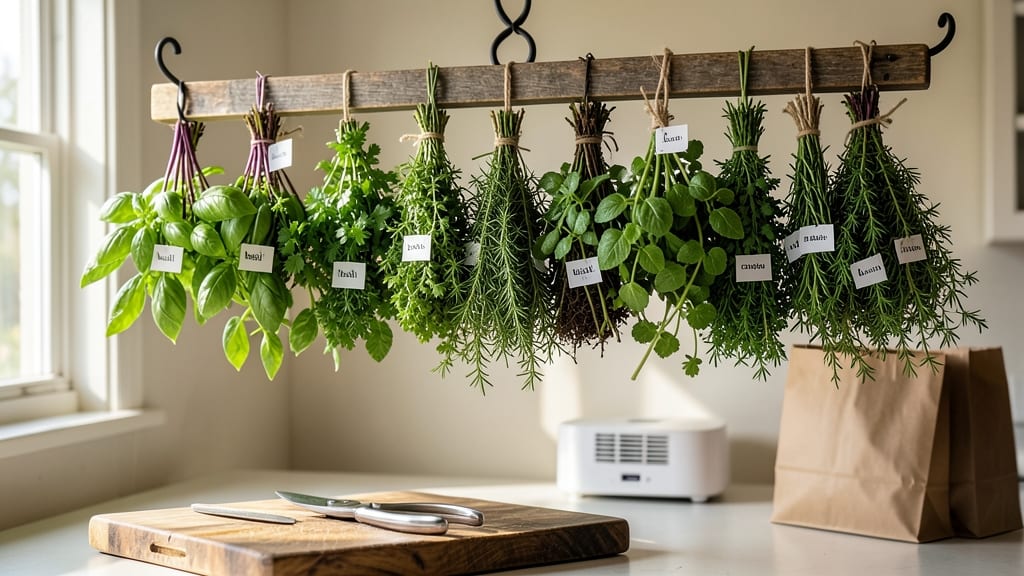
To dry fresh herbs from the garden, harvest them in the morning after dew dries, strip leaves from stems, and choose from four methods: air-drying (hang bundles upside down), oven-drying (low heat, 170°F), dehydrator (95°F for 1-4 hours), or silica gel (ideal for delicate herbs like basil). Store in airtight containers away from light for up to 1 year.
Timing matters most when drying herbs—morning harvests capture peak essential oils before heat evaporates them. 🌿 Air-drying works best for hardy herbs like rosemary and thyme, while delicate leaves (basil, cilantro) crisp in dehydrators or silica gel.
Oven-drying speeds things up but requires constant monitoring to avoid burning. The key is balancing temperature and airflow to preserve flavor without encouraging mold growth.
After drying, proper storage extends shelf life. Glass jars with tight seals block light and moisture, while brown paper bags let herbs breathe. Label containers with the herb name and drying date—some varieties (like dill) lose potency faster than others.
For maximum freshness, crush leaves just before use to release trapped aromas.
💡 In This Article
- Optimal Harvesting and Drying Conditions for Garden Herbs
- Step-by-Step Guide to 4 Herb Drying Techniques
Optimal harvesting and drying conditions for garden herbs
The best time to harvest herbs is within 2-3 hours after morning dew evaporates—typically between 8-10 AM. This timing captures peak essential oils when plants are fully hydrated but before afternoon heat causes evaporation.
For example, rosemary's volatile oils (like camphor) reach their highest concentration in the morning, while basil's delicate compounds degrade faster in heat. 💫 The cooler morning air also prevents enzymatic browning that occurs when leaves are exposed to sunlight and warmth.
Humidity levels below 50% create ideal drying conditions by accelerating moisture loss without promoting mold. High humidity traps water in leaves, creating a breeding ground for fungal growth. Airflow is equally critical—stagnant air slows drying and weakens flavor.
For instance, herbs dried in a well-ventilated area like a screened porch lose 80% of their moisture in 5-7 days, while those in a closed space may take twice as long. The goal is to reduce moisture content to 10-15% to preserve potency.
Temperature plays a delicate balancing act: too high causes oxidation (flavor loss), while too low risks mold. Air-drying at 65-75°F works for hardy herbs like thyme and oregano, but delicate varieties need controlled environments.
For example, parsley dried at 95°F in a dehydrator retains 90% of its chlorophyll (key for vibrant color), whereas oven-drying at 170°F can scorch leaves if monitored improperly. The sweet spot is maintaining a consistent 5-10°F difference between ambient and leaf surface temperatures.
Light exposure affects both safety and quality. Direct sunlight causes chlorophyll breakdown, turning herbs yellow and reducing antioxidant levels. Instead, use indirect light or fluorescent bulbs (which emit less heat).
For instance, basil exposed to direct sun loses 30% of its vitamin K within 24 hours, while shaded drying preserves 95% of its nutritional profile. The same principle applies to storage—UV light degrades essential oils over time, which is why dark glass jars outperform clear containers.
Herb anatomy also matters: broad-leaved varieties (like mint) dry faster than needle-like ones (like rosemary) due to surface area differences. Mint's large leaves expose more moisture to air, while rosemary's needle structure requires 10-14 days of drying.
This is why some gardeners bundle herbs differently—mint in loose clusters for quick drying, while rosemary in tight bundles to protect its needle structure from breaking. The texture difference after drying is striking: mint becomes crisp and papery, while rosemary maintains a slightly woody yet brittle form.
One often-overlooked factor is the cutting technique. Harvesting with clean, sharp scissors (not tearing) prevents bruising that accelerates moisture loss and flavor degradation. For example, basil stems cut at a 45-degree angle create more surface area for drying, while torn leaves develop uneven moisture distribution.
The same principle applies to stripping leaves: gently rubbing stems against a bowl's edge removes leaves faster than pulling, which can damage the plant's oil glands. 🌿